
A Morning on Foot: Bush Walking with Natie & Jacques in Dinokeng
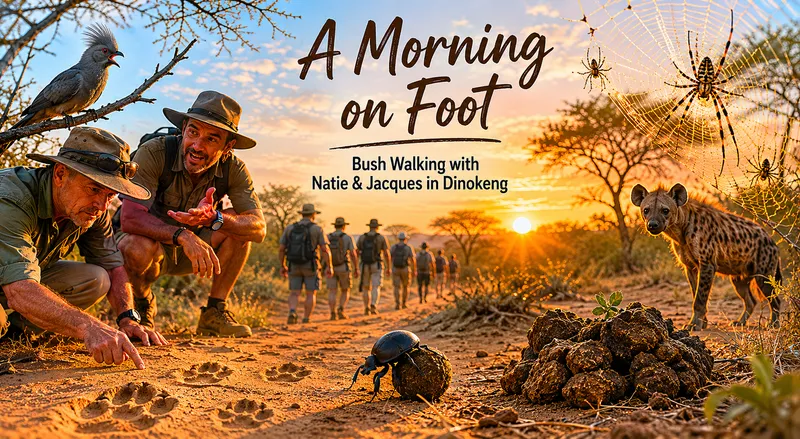
It's early morning. The day hasn’t fully woken up yet. Bird alarm clocks have turned the silence of the night into a call to duty while the moon slowly says goodbye in the west and the sun begins stretching itself over the eastern horizon.
We gather at Arlington with boots tightened and jackets zipped. Suddenly a Grey Lourie calls its usual "go-away!" from a branch above us, apparently convinced it needs to warn the bushveld that a group of humans is about to enter the wild.
Not entirely sure whether it was telling us to go away... or warning the wildlife to go away.
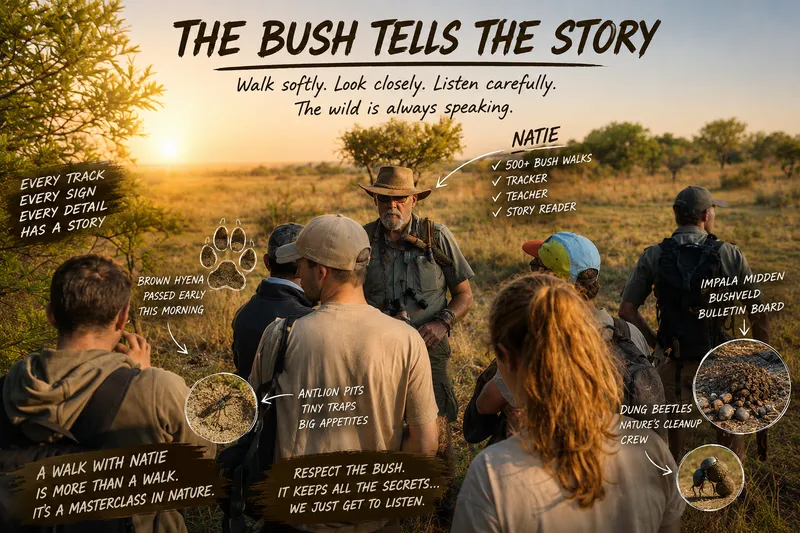
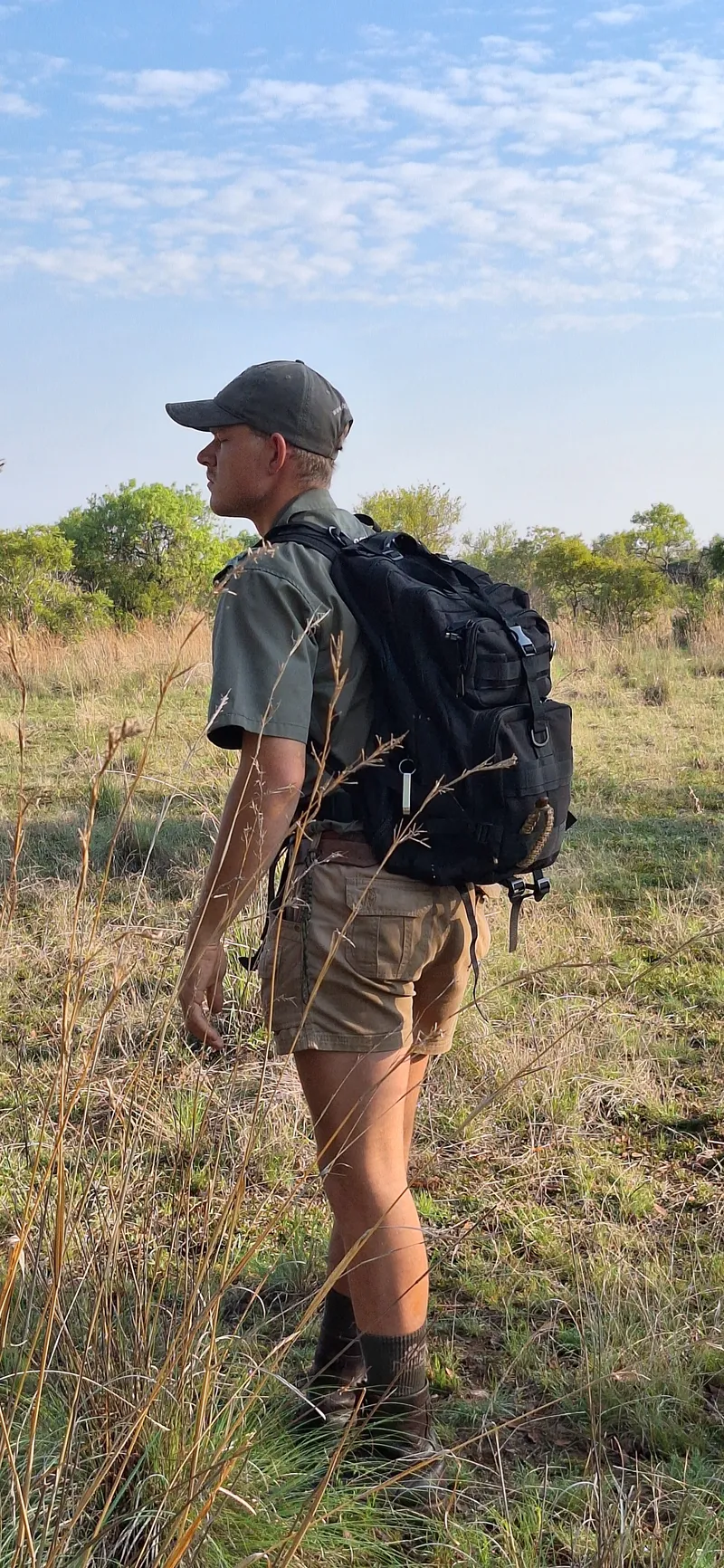
Natie steps forward in his calm, focused fashion, carrying with him the quiet confidence of a man with more than 500 bush walks behind him.
Alongside him this morning, moving with youthful enthusiasm and already carrying a spark of mischief in his eye, is Jacques — hinting that this walk will contain equal parts knowledge and entertainment.
THE PRE-WALK BRIEFING — Serious, Focused and Respected
Before a single foot touches the veld, Natie gathers the group into a tight half-circle.
His tone is calm, but serious.
"Please listen carefully. A bush walk is one of the most rewarding experiences you can have, but there are also serious risks if we do not follow the rules."
"I'm in charge and Jacques is my backup for your safety. Follow our instructions immediately because if one person makes a mistake, it doesn't just affect you — it can put the whole group at risk."
Single file always.
Move quietly.
Follow my signals immediately — stop, crouch, move, freeze.
No sudden movements.
Never run.
"Running triggers hunting instincts — and we are not here to become breakfast."
Stay close enough for control and immediate reaction.
There are no jokes here. Everyone understands the message. Out here nature makes the rules and we simply respect them.
With the safety briefing now done, Jacques gives a small harmless grin from the back of the group.
Knowing Jacques, I realize immediately that while safety comes first, there will almost certainly be some entertainment along the way as well.
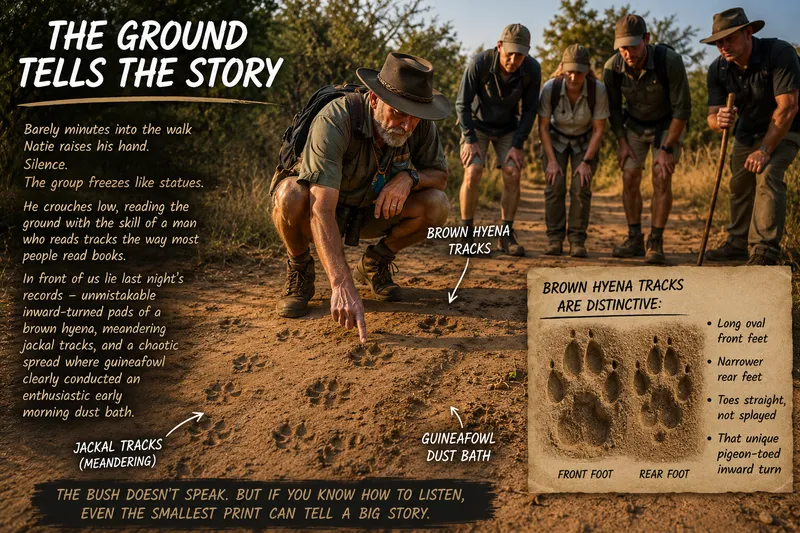
The Ground Tells the Story
Natie leads the way as we head out from Arlington walking across the Self drive road in a northerly direction into the open wilderness area.
Barely minutes into the walk Natie raises his hand. The group freezes like statues.
He crouches low, reading the ground with the skill of a man who reads tracks the way most people read books.
In front of us lie last night's records — unmistakable inward-turned pads of a brown hyena, meandering jackal tracks, and a chaotic spread where guinea-fowl clearly conducted an enthusiastic early morning dust bath.
Brown hyena tracks are distinctive:
Long oval front feet
Narrower rear feet
Toes straight rather than splayed
That unmistakable pigeon-toed inward turn
Natie points quietly. "Brown hyena. Passed here early this morning. Very fresh."
Hyenas — especially brown hyenas — are secretive, shy animals that are seldom seen during daylight hours.
Jacques comments: "Brown hyenas are introverts — shy, secretive, avoid people..."
I quickly interject, rather sarcastically: "Basically the complete opposite of YOU, Jacques."
The group laughs. Natie simply shakes his head and turns to lead the way again
The Bushveld Newspaper
A few minutes later we arrive at what appears to be the bushveld's most popular communal toilet.
Natie asks whether anyone knows what it's all about.
Only surprised faces look back at him.
After a brief silence Jacques jumps in. "Bushveld bulletin board. All the impala gossip right here." its a An impala midden.
Perfectly circular, neat and layered like a biological record book, for other to recognize Dominance, Territory, Health status, and Readiness for mating.
Everything communicated chemically.
Impala identify one another through pheromones.
Females assess males and Males establish territory ownership.
Predators learn herd patterns.
All from a pile of dung.
Who said social media was a modern invention?
Golden Orb Spider
As sunlight starts filtering through the trees, smaller wonders begin revealing themselves and Jacques becomes a walking encyclopedia of enthusiasm.
Suddenly Natie stops again.
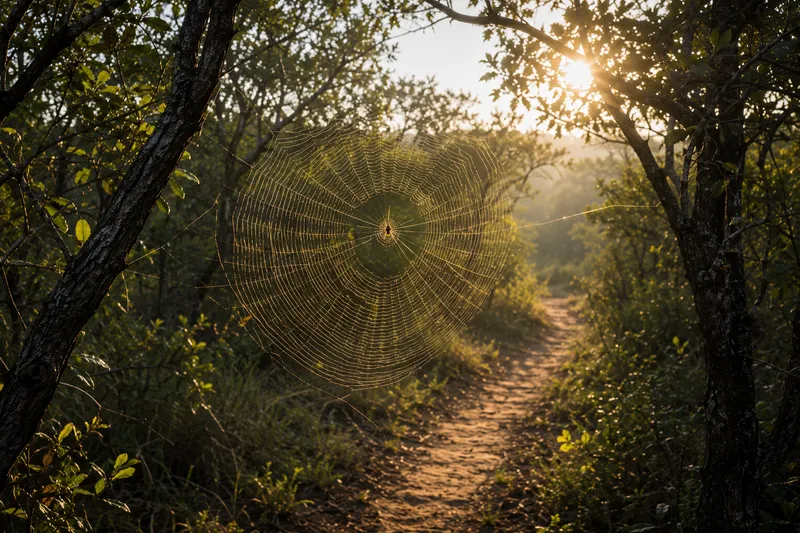
Above us morning light shines through an elaborate golden web stretched between trees, with rather large spider in the center,
"Golden Orb Spider."
One of the most impressive spiders you'll encounter in southern Africa.
Jacques pulls a strand from the web and rolls it carefully between his fingers, letting guests pull against it.
Nobody manages to break it.
Golden Orb silk is among the strongest natural fibers found in nature.
The web glows with its famous yellow-golden colour in the morning light.
Scientists believe the colour may help attract insects while also blending into surrounding vegetation.
Some webs can exceed two metres across.
Someone asks: "Are they dangerous?"
Natie answers calmly: "They look intimidating but are generally harmless and avoid people."
Then comes the question: "Male or female?"
Jacques grins — the kind of grin only a young guide can give when you can already see the mischief loading in his mind.
He answers: "The female sits in the centre and is much larger. The tiny male sits on the edge looking very brave... or very nervous."
He pauses for effect. "Survival tactics 101 — stay on the edge, choose your timing carefully, do your job quickly and retreat."
I smile and quickly jump in: "Imagine going on a date where you're one-tenth the size of your partner and your exit strategy suddenly becomes the most important part of the evening."
Tiny Sand Ninjas
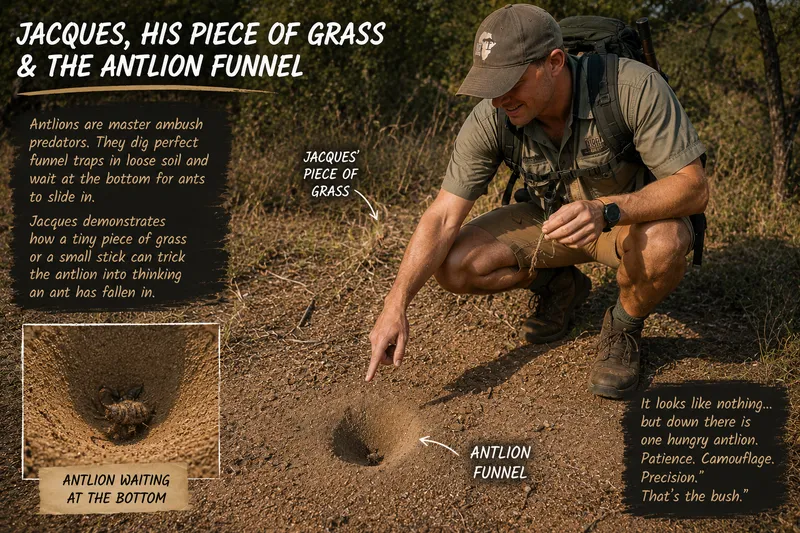
A little later Jacques suddenly kneels beside a patch of soft sand. Tiny conical pits lie beneath a bush.
"Little sand ninjas waiting for ants to fall into their doom."
He lightly tickles the sand with a piece of grass. Moments later something grabs it.
Soon Jacques has the tiny creature displayed on his hand for everyone to see.
Antlions.
Most people walk past them every day without noticing.
Tiny predators buried beneath the sand with curved jaws simply waiting for lunch to arrive.
"Antlions may be the only predators that built a restaurant and waited for the food to walk in."
Nature's Cleanup Crew
We continue walking until a tiny beetle, rolling a perfectly formed ball backwards across the path, causes the entire group to stop.
"What is that?" someone asks.
Dung beetle.
Possibly one of the hardest-working creatures in Africa.
Nature's recyclers.
Gardeners.
Engineers.
The sanitation department.
Or as Jacques immediately announces:
"Dung Beetles — The Bushveld Municipality's Employee of the Month."
When elephants, rhinos, buffalo, zebra and antelope leave their contributions behind in the bush, dung beetles quickly move in for duty.
Southern Africa is home to more than 700–800 species, depending on the region. Some species are surprisingly fussy and prefer only certain animals' dung — elephant, rhino and others. Then you also get specialists like the famous Flightless Dung Beetle, which is considered vulnerable.
They also all work differently.
Rollers roll their prized package away.
Tunnelers dig beneath and bury it underground.
Dwellers simply move in permanently and decide they quite like the neighbourhood.
Without dung beetles the bush would become a rather unpleasant place very quickly.
Then comes one of the best facts of all.
Dung beetles had their own GPS long before humans ever thought they were clever enough to invent one.
They use the Milky Way for navigation.
When we lose signal on our phones, these little guys simply look at the stars.
Jacques can't resist adding one last comment:
"The Poo Professors..." He pauses.
"Experts in advanced ball management."
The group bursts out laughing while the little municipal worker carries on with his duties completely unimpressed by his growing audience.
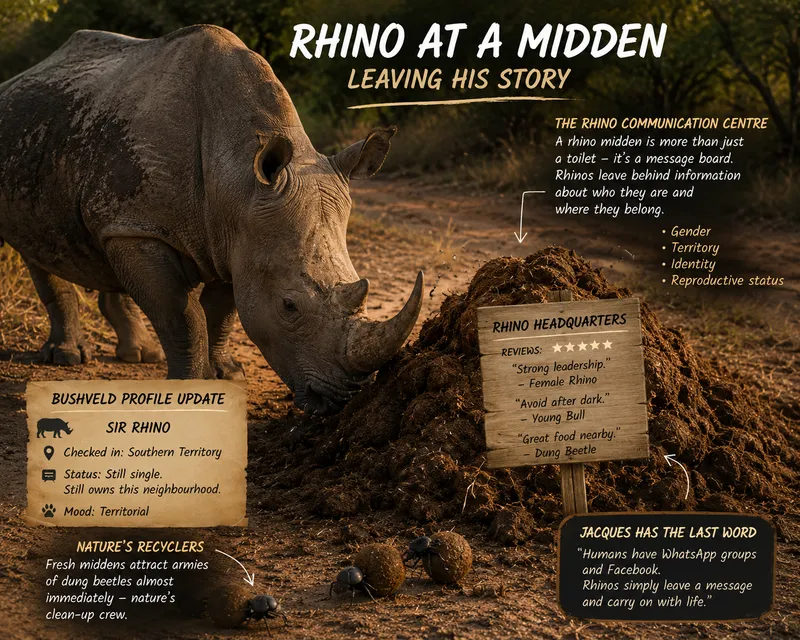
The Rhino Communication Department
Later we come across a huge mound of dung.
Scattered.
Untidy.
Impressive.
Natie taps it gently.
"Rhino midden."
A communication centre.
Rhinos leave information about:
Gender
Territory
Identity
Reproductive status
Basically:
Bushveld Profile Update
"Sir Rhino: Male. Still single. Still owns this neighbourhood."
Fresh middens attract armies of dung beetles almost immediately.
Jacques has the last word again.
"Humans have WhatsApp groups and Facebook. Rhinos simply leave a message and carry on with life."
A Final Fresh Clue
As we near Arlington again, the sun is now well above the horizon, warming up the day.
Suddenly Natie's hand goes up.
Everyone freezes.
Natie speaks quietly.
"Fresh tracks. Very fresh."
He points at the ground.
Crisp edges.
No wind disturbance.
"Passed here minutes ago."
Spotted hyena.
Everyone suddenly starts looking around, wondering whether they are perhaps being watched from somewhere nearby.
The tracks resemble dog prints — but not quite.
Four toes.
Claw marks.
Larger front tracks.
Oval-shaped.
The middle toes sitting slightly ahead.
People often think hyenas are just scavengers.
In reality they're highly effective hunters.
I comment:
"Camping off-grid can be interesting. You wake up with your first cup of coffee and notice tracks outside camp, wondering whether a hyena walked past during the night, sniffed around and added your campsite to the neighbourhood gossip network... then you notice the corner of your solar panel looks suspiciously chewed."
Jacques immediately interrupts:
"No... he walked past your camp, looked at your braai setup and judged your fire-making skills."
The group laughs quietly, although I notice one or two people suddenly checking over their shoulders again.
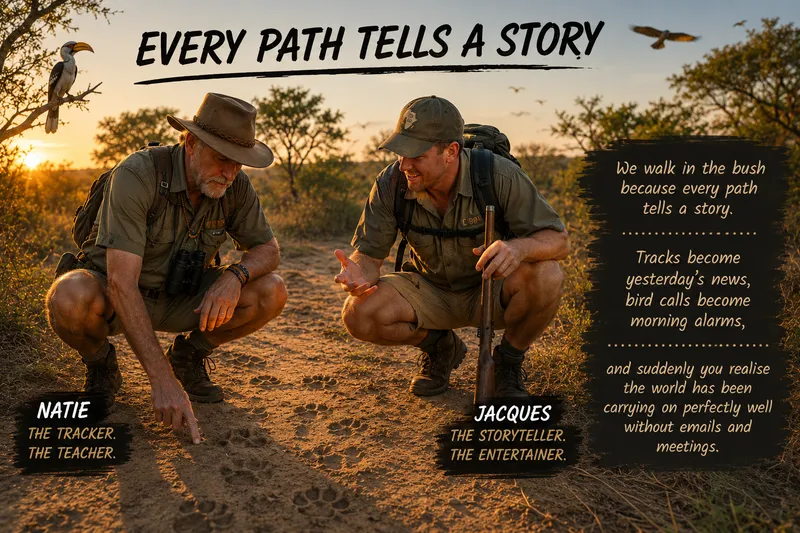
Why We Walk
As we walk back through the Arlington gates, Natie turns and says:
"Thank you everyone for a wonderful walk. We trust you enjoyed it as much as we did."
Someone asks:
"Do you do this every day?"
Natie smiles quietly before answering:
"We walk in the bush because every path tells a story. Tracks become yesterday's news, bird calls become morning alarms, and suddenly you realise the world has been carrying on perfectly well without emails and meetings."
We return dusty, hungry and smiling — carrying that strange satisfaction only a proper bush walk brings.
A walk with Natie is discipline, knowledge and understanding the bush as a living system.
Jacques brings warmth, humour and curiosity.
Together they create something special — an informative bush experience that can really only be appreciated on foot, with two guides who each bring something different to the journey.
A walk that is:
Respectful.
Educational.
Safe.
Memorable.
And exactly the kind of magic the Dinokeng Game Reserve does best — and one of the many reasons Thorn Tree Bush Camp is proud to call this wild place home.