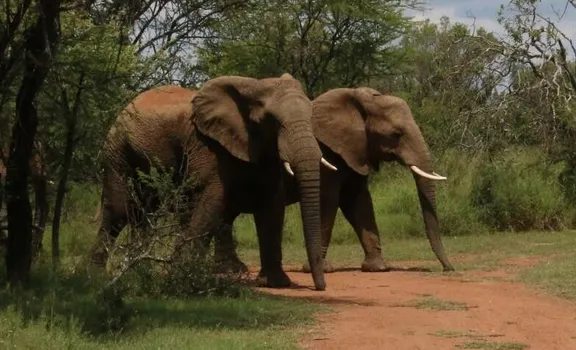

Wisdom Beneath the Thorn Trees #1: Stinky the Fence-Breaking Elephant of Dinokeng
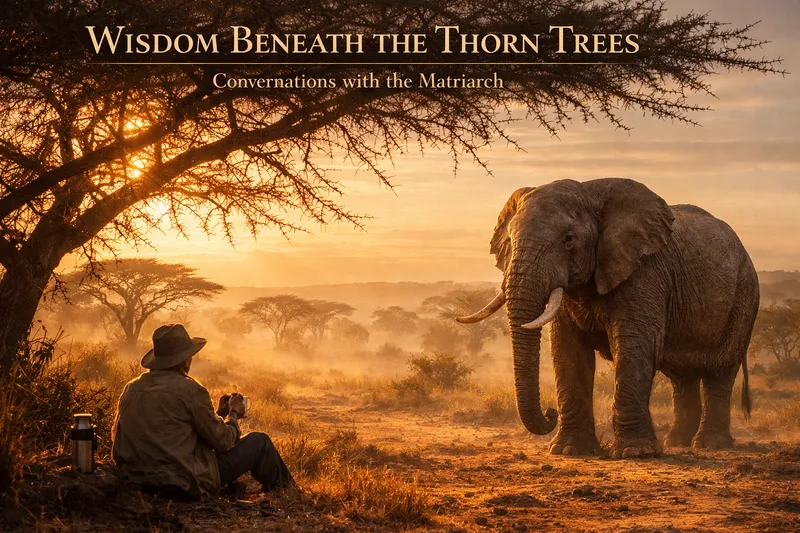
Conversations with the Matriarch
Nine broken fences. One curious young Dinokeng elephant.
Naturally, a few landowners were not particularly impressed.
But later that afternoon an old elephant matriarch reminded me of something important about fences, young bulls… and humans.
The bushveld has a way of teaching you things, but it never seems to hurry.
At Thorn Tree Bush Camp, mornings often begin quietly beneath a thorn tree with a mug of coffee while the bush slowly wakes up. If you sit long enough and listen carefully, the land has a habit of sharing its stories.
Sometimes the lesson comes from a hornbill hopping energetically across the sand.
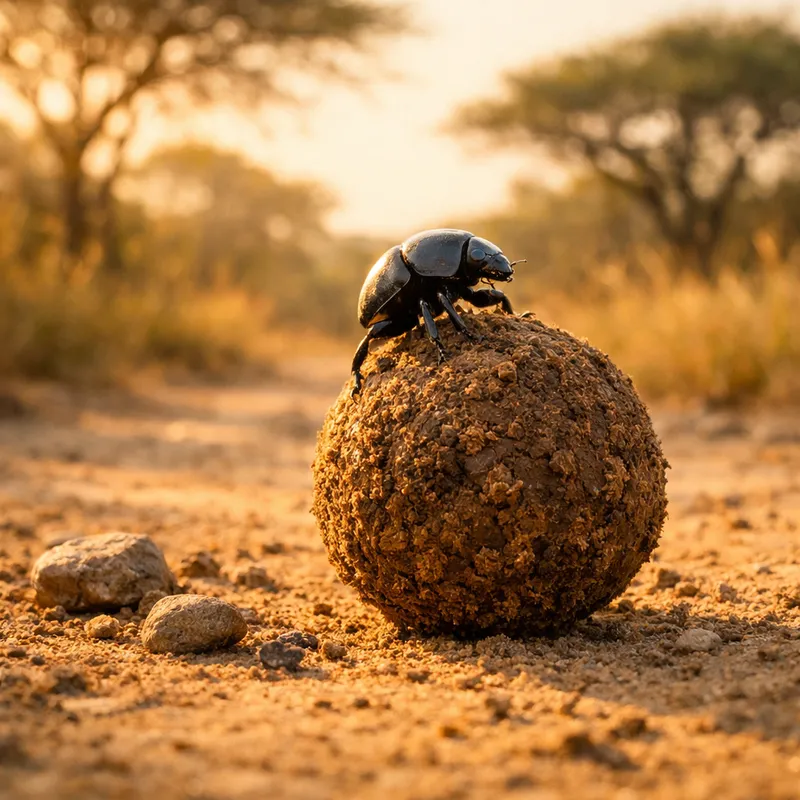
Sometimes from a dung beetle rolling its perfectly round treasure across the road with the determination of a creature that clearly has no interest in anyone’s opinion.
But occasionally, if you are lucky, the lesson comes in the form of an old elephant matriarch — who seems to carry the memory of the land itself.
Over time I began to notice that many of the questions that trouble us as humans appear quietly reflected in the lives of the animals around us.
And so, while sitting beneath the thorn trees watching the bush unfold day after day, these reflections slowly took shape as a series of conversations between myself and the Matriarch.
Not because elephants talk to us, of course. But because if you spend enough time in the bush, you begin to realize something rather humbling.
Nature has been speaking to us all along. We have simply forgotten how to listen.
“The wilderness is alive, and its whispers are there for all to hear—if we are quiet enough to listen.”
— Lawrence Anthony, The Elephant Whisperer
This is the first of those reflections.
And like many bush stories, this one begins with a young elephant bull named Stinky… and nine broken fences.
Stinky and the Broken Fences
The Dinokeng Game Reserve bushveld was still quiet that morning when I opened the latest reserve management report.
Dawn was only just beginning to stretch across the land. The sky held that soft blue-grey colour that appears just before the sun finally rises above the thorn trees.
Somewhere in the distance a francolin had already begun shouting loudly, convinced — as he is every morning — that the rest of the world might oversleep if he did not start the day with the morning alarm bells.
I sat outside with my coffee, reading the report on my tablet.
Reserve reports are fascinating things. They are glossy documents that attempt to summarise the wonderfully chaotic life of a game reserve into tidy bullet points and neat sentences.
Occasionally they succeed. More often they simply reveal how delightfully untidy nature really is.
One line in particular caught my eye — and it explained why several neighbouring landowners were having a very bad week.
“Nine elephant breakouts during the last period.”
Nine.
I read it again.
Yes, it was nine elephant breakouts — and that usually means one thing.
Somewhere along the fence line, an elephant has been having a rather animated discussion about the meaning of property boundaries.
Judging by the reports from landowners and neighbouring farms, those discussions had been rather heated at times, with landowners far less amused about the midnight visits and the resulting damage.
Several fences flattened.
A few trees pushed over.
In short, someone had been conducting a fairly serious midnight inspection of the fence engineering standards.
I took another sip of coffee and smiled, thinking there could only be one such mischievous teenage fence inspector in the DGR.
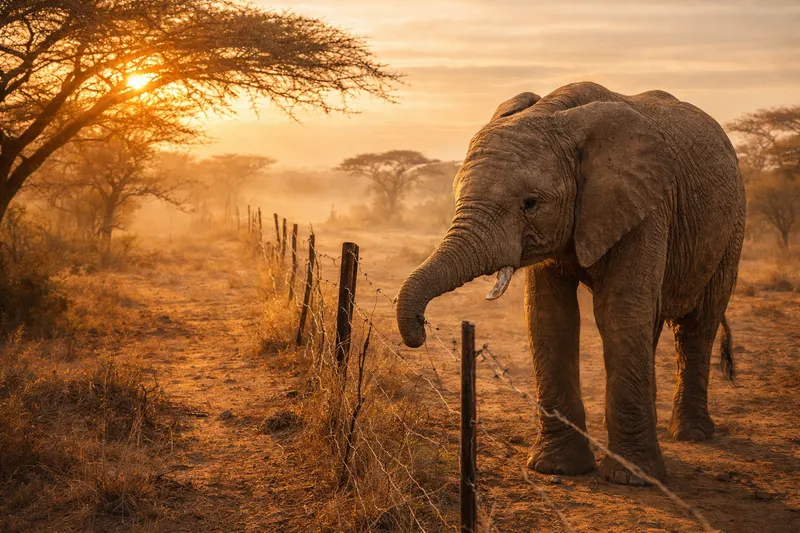
The Youngest Bull
To landowners he is known simply as Stinky.
I am not entirely sure how he acquired the name. Like many nicknames in the bushveld, the origin has long since been forgotten while the name stubbornly remains.
Stinky is the youngest bull that regularly wanders through the southern parts of the reserve, sometimes accompanied by his brothers. The southern section of the reserve also happens to be the most populated by humans and includes the self-drive routes.
Most landowners recognise him by the unmistakable air of youthful curiosity that seems to accompany him wherever he goes.
In short, Stinky is at that familiar stage of life — the elephant equivalent of a teenager, not very different from his human counterparts of the same age.
Young bulls spend their early years safely within the herd, surrounded by mothers, sisters and aunts under the watchful leadership of the Matriarch.
But eventually the day comes when the young bulls — now teenagers — leave the herd and begin walking their own path.
It may sound rather familiar to many parents.
Around this time they begin discovering their size, their strength, and the surge of hormones that makes life even more confusing.
Unfortunately, they have not yet discovered the responsibilities that come with these new changes.
So they begin experimenting with the world around them.
They test the strength of trees.
They test each other.
And occasionally… they test fences — and human patience.
His Teachers
Stinky has had excellent role models.
Older bulls such as Charls, Lumpy and Hotsuff used to spend many days in this part of the reserve — enormous animals that carried themselves with quiet authority. In their younger days they became somewhat infamous as fence breakers, so later both Charls and Lumpy were moved and now roam the Zinave National Park in Mozambique.
In their younger days, however, they became something of experts at testing boundaries — fences, gates and occasionally the patience of those responsible for maintaining them.
At the time, Stinky was still a young bull with a very curious mind, and he appeared to watch these lessons with great interest from the safety of the herd beside his mother.
And judging by the GM’s report on my tablet, he had clearly been paying attention.
Stinky was now conducting extensive field research of his own.
Nine breakouts.
Our fence maintenance team has since developed a rather personal interest in Stinky’s research programme.
An Afternoon Visit
Later that afternoon the bushveld returned to its usual rhythm, getting ready to end the day and settle down after sunset.
The heat softened. Birds resumed their quiet activity. Long shadows stretched across the sandy ground.
I was checking the camp perimeter but still thinking about the report when I noticed movement among the thorn trees.
The Matriarch.
She stepped forward out of the bush moving toward me as if to say afternoon - how has your day been.
There is something about a matriarch that commands respect. They move slowly and deliberately, as though time itself has agreed to slow down around them.
She stood quietly for a moment, her ears gently moving in the breeze.
Then her eyes settled in my direction.
“Well,” I said, raising my hand slightly in greeting.
“I was just reading about one of your young students.”
She stood still.
“The report says there have been nine breakouts recently.”
“And judging by the footprints along the fence line, our friend Stinky appears to be responsible.”
The Matriarch calmly pulled a branch from a nearby thorn tree.
Unhurried.
Patient.
as if to say any you are surprised at the behavior of a typical teenage bull where and older bull to teach is not around. I can teach theme certain lessons in life then its up to the older bulls - and we do not have an older bull in the DGR.
The Human Theories
There are several explanations,” I continued.
“Elephants are attracted to the citrus and marula trees planted inside the landowners’ fenced areas. To an elephant those are not garden decorations — they are invitations.”
“Or it may simply be that the teenager, Stinky, enjoys testing fences. And a few suspect he may just dislike certain landowners entirely"
I shrugged.
“Whatever the reason, the neighbours are not particularly enthusiastic about having their fences redesigned.”
The Matriarch fed quietly for a moment before she responded.
The Matriarch’s Perspective
“You speak of the young bull learning,” her presence seemed to suggest.
“But perhaps humans still have some learning to do as well.”
“I agree,” I said.
She lifted her head slightly, looking toward the distant fence line.
“Humans like to divide the world into pieces with fences.
My land.
Your land.
This reserve.
That farm.”
She paused.
“But in nature, the bush has never worked like that.”
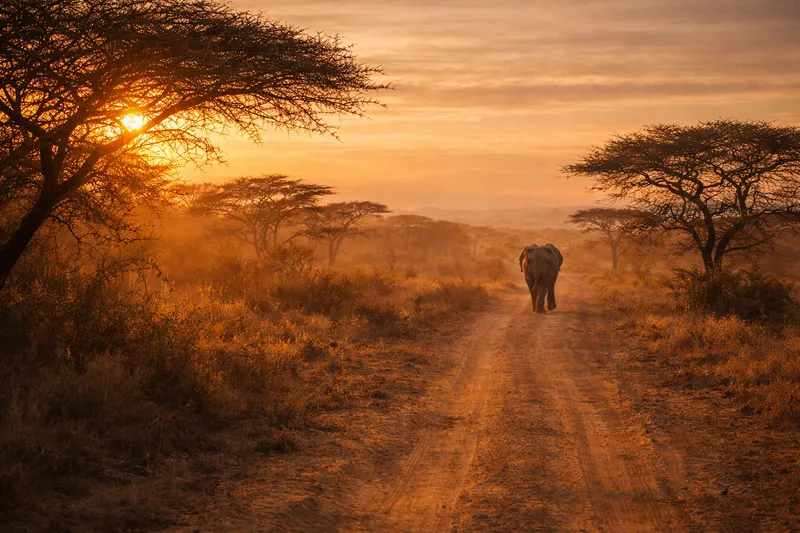
“For centuries elephants have followed ancient pathways between water, grazing and seasonal food.”
“The land was never divided. We could move long distances, never overgrazing and preventing an overburden of parasites.”
“You humans, on the other hand, build fences to protect what you value.”
“To protect your crops. Your homes. Your trees. To keep us out — or sometimes to keep us contained.”
Then she pulled another branch from the thorn tree.
“But sometimes you forget that the land was never divided to begin with.”
I considered that for a moment.
“That is fair,” I admitted. “If we wish to live beside wild animals, we must learn to adapt.”
She continued.
“You wish to hear lions at night.”
“You wish to see elephants walking through the bush.”
Her ears shifted gently in the breeze.
“And yet you still build fences.”
I laughed quietly.
“That is something Stinky clearly believes should be tested from time to time — perhaps even redesigned.”
The Matriarch stood quietly.
Then the lesson seemed to arrive.
The Matriarch reminded me of something important:
“Young bulls need to learn where the fences are.
And men need to learn why the fences were built.”
Where Two Worlds Meet
That, of course, is the great challenge of modern conservation — and one that places like the Dinokeng Game Reserve continue to navigate if they hope to become a model for the future.
Humans and elephants now share the same landscape. That means we must adapt our ways and reconsider how we use fences. They may still be necessary, but we must remain aware of the challenges they present for both humans and wildlife.
We build fences to protect communities and farms.
At the same time, we work to preserve the wild freedom that makes places like Dinokeng so special.
And somewhere between those two worlds walks a young bull like Stinky — enthusiastically testing the boundaries of both.
Young bulls are not destructive by nature.
They are simply learning.
Full of strength.
Full of curiosity.
Full of testosterone.
Still discovering when to use one — and when to restrain it.
In a natural elephant society, older bulls normally provide that guidance.
A rumble.
A warning.
Occasionally a brief confrontation.
And suddenly the younger bull learns that strength alone does not make him master of the bush.
Wisdom must walk beside it.
Unfortunately, in this part of the reserve there is currently no truly old bull — the kind of experienced giant that would normally guide younger males. Bulls such as JJ and Tiny Tim are still relatively young themselves, and the presence of a fully mature bull — perhaps forty-five years old or more — is something nature would normally provide.
And until an older bull arrives to remind him of the rules, the fences of Dinokeng may continue to feature prominently in Stinky’s education.
Humans Try to Help
Of course, the modern world complicates things.
When fence-breaking becomes frequent, reserve managers sometimes need to step in.
Veterinarians may collar the elephant to monitor its movements, or use GnRH treatments that reduce testosterone and aggressive behaviour — something that older bulls would normally regulate within the natural social hierarchy.
Across Africa, conservationists are also experimenting with a variety of creative solutions, such as beehive fences, chili deterrents and improved fence designs. Researchers are even beginning to explore elephant communication — a fascinating topic all on its own.
All of this work shares the same goal:
Finding ways for humans and elephants to share the same landscape with fewer arguments about boundaries.
The final chapter on elephant behaviour and management in smaller reserves, however, is still far from complete — and perhaps it never will be.
Somewhere in the Bush Tonight
As the Matriarch slowly disappeared back into the trees, the real lesson settled quietly in my mind.
Perhaps Stinky is not simply a troublemaker.
Perhaps he is just walking the same road every young creature must walk — learning to understand himself and the world around him.
We humans walk that road too. We test boundaries. We challenge fences.
And along the way, life introduces teachers who remind us that strength alone is never enough.
Somewhere out there tonight, Stinky is still wandering through the reserve, his movements now tracked by a new collar. Perhaps the GnRH treatment has calmed him enough to help him understand that the scent of marula fruit behind those fences is not meant for him.
Or perhaps he is simply inspecting another fence with professional curiosity.
The bush had grown quiet again.
The sun was now low in the sky, so I nodded a quiet farewell to the Matriarch and headed back toward the house.
Perhaps the Matriarch was right.
Young bulls must learn where the fences are.
And humans…
are still learning why we built them.
Life at Thorn Tree Bush Camp constantly reminds us that we share this land with extraordinary teachers — some large, some very small.
If you spend enough time quietly beneath a thorn tree, the bush eventually shares its wisdom.
This story takes place in Dinokeng Game Reserve, the only Big Five reserve in Gauteng, where elephants, lions, buffalo, rhino and leopard roam freely across 18,000 hectares of bushveld.
“But ask the animals, and they will teach you…”
— Job 12:7
Until next week beneath the thorn trees.
Next time, the Matriarch introduces me to another unlikely teacher:
A dung beetle.