New Year’s Resolutions, According to the Bush
Two very different mothers, one midnight dam, and the quiet wisdom the bush offers when humans finally stop talking.
While humans count down and make promises, the bush carries on — raising cubs, weighing survival, and gently laughing at our resolutions.
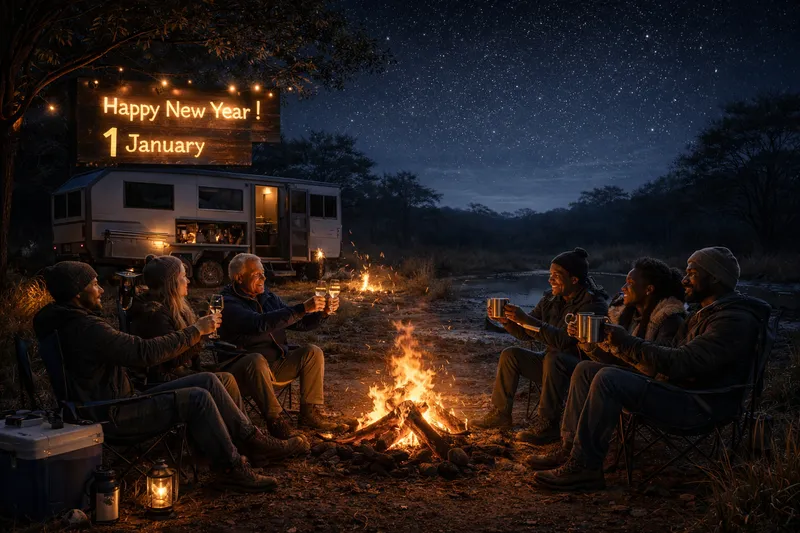
Humans gather around fires as if summoned by some ancient instinct — braai tongs clenched like ceremonial weapons, one eye on the coals and the other glued to a glowing phone. Meat sizzles obediently. Someone — always someone — announces that this is not how they normally braai at home, and proceeds to explain it anyway. Laughter floats across the veld, mixed with wood smoke, optimism, and a faint sense of overconfidence.
In the long grass nearby, the animals wait.
They always do.
As midnight creeps closer, humans begin the sacred ritual: counting backwards with great seriousness, shouting “Happy New Year!” into the bush as if it might answer, clinking glasses, hugging strangers, and making promises that will not survive the first working day of January.
Then — almost magically — they vanish.
Tents zip shut. Camp chairs scrape. Fires sigh and give up.
Silence returns.
The proper kind.
And that’s when the real conversations begin.
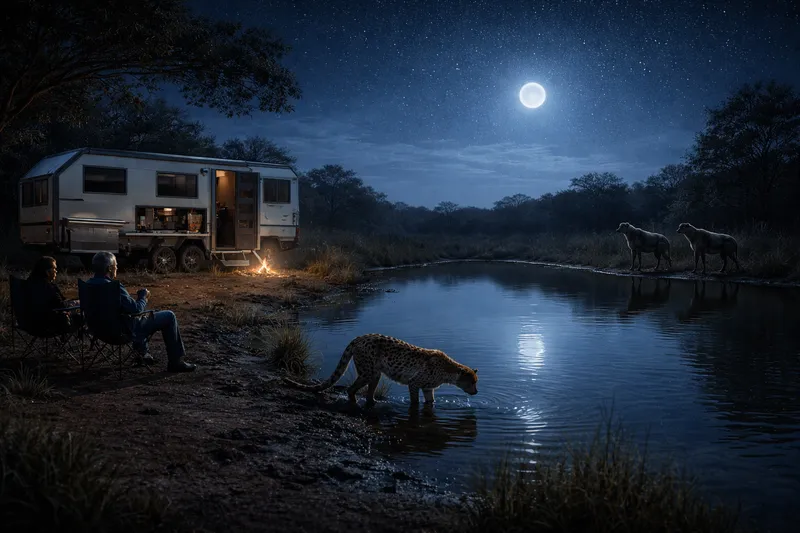
Midnight. 31 December. -The Dam Near the Off-Grid Camp
The small dam near the off-grid site lay perfectly still, reflecting stars as it had long before caravans, clocks, or humans decided that shouting at midnight might improve the future. It had always drawn animals for water — and, occasionally, for something else entirely: pause.
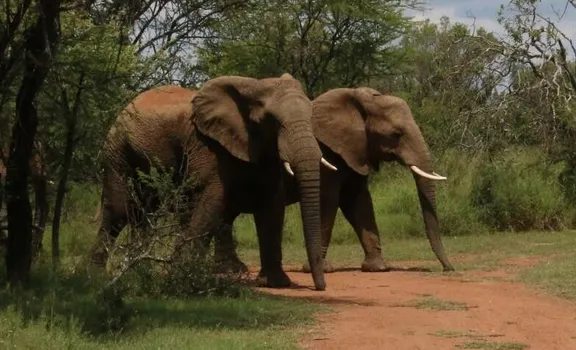
From the reeds, an elephant bull shifted his weight, listening. Above him, birds settled into branches, curious but cautious. Midnight had arrived. The bush had noticed.
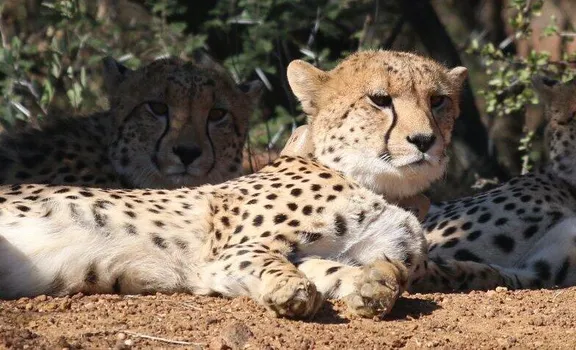
On one side of the dam, a cheetah mother appeared quietly.
Slim. Alert. Already tired.
She drank fast, never fully lowering her head, eyes sweeping the darkness with the practiced precision of someone who understands that survival is not luck — it is a long series of small, correct decisions made without applause.
Across the water, the hyena matriarch arrived.
Not quietly.
Not alone.
And certainly not apologetically.
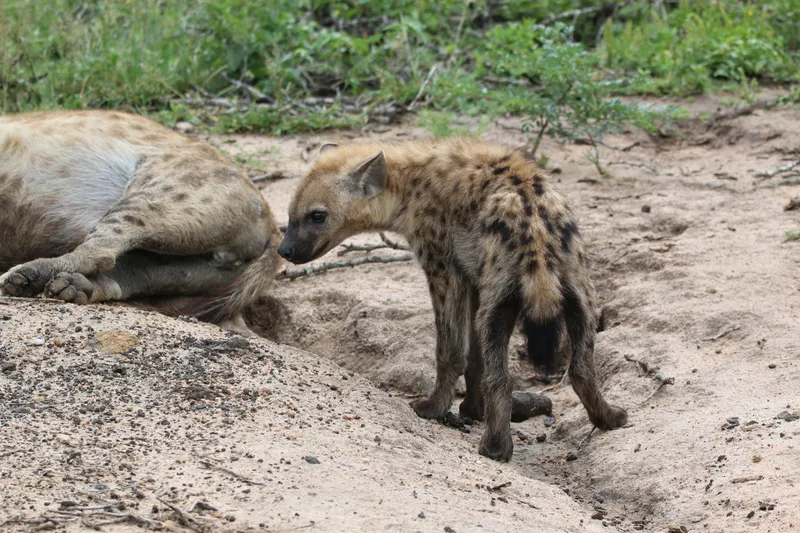
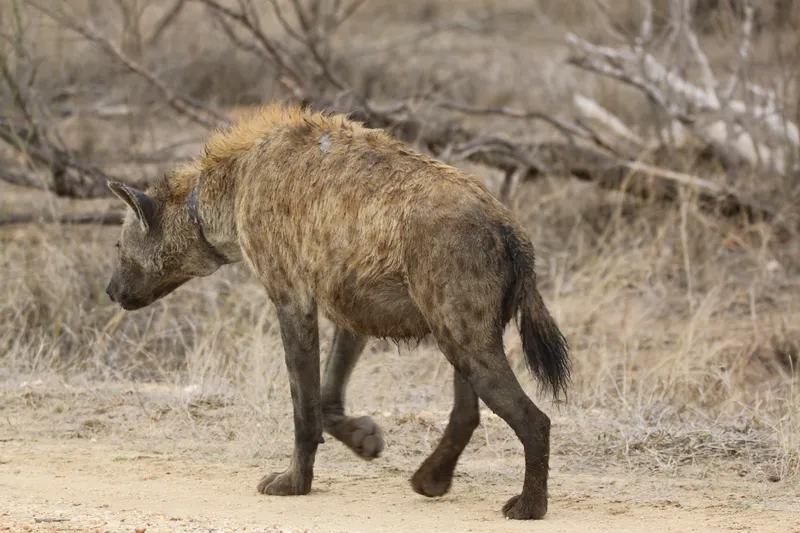
Her clan hovered behind her in restless shapes, snickers and whispers bubbling just below the surface. They carried confidence the way others carry scars — openly and without explanation.
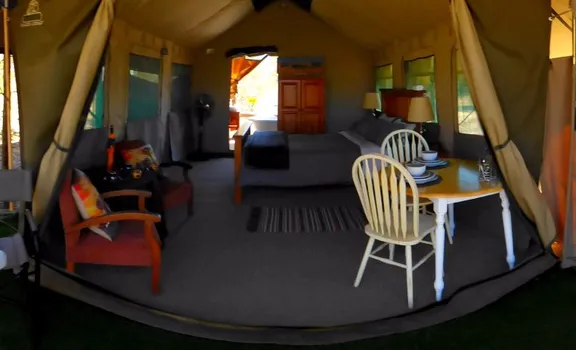
A few metres away, barely visible in the shadows, Rodney and Elzabé sat outside their Infanta caravan, mugs warming their hands. They said nothing. They listened. They smiled — long familiar with the fact that some of the most important bush conversations are not meant to include humans.
The cheetah exhaled slowly.
“So,” she said, eyes still scanning the dark,
“another year.”
The hyena grinned, teeth flashing faintly in the starlight.
“We survived it,” she said.
“That already puts us ahead of most New Year’s resolutions.”
Somewhere behind them, the elephant flicked an ear.
Above, a bird shifted, amused.
And at the edge of the dam, two very different mothers prepared — once again — to discuss the serious business of raising young in a world that never stops testing them.
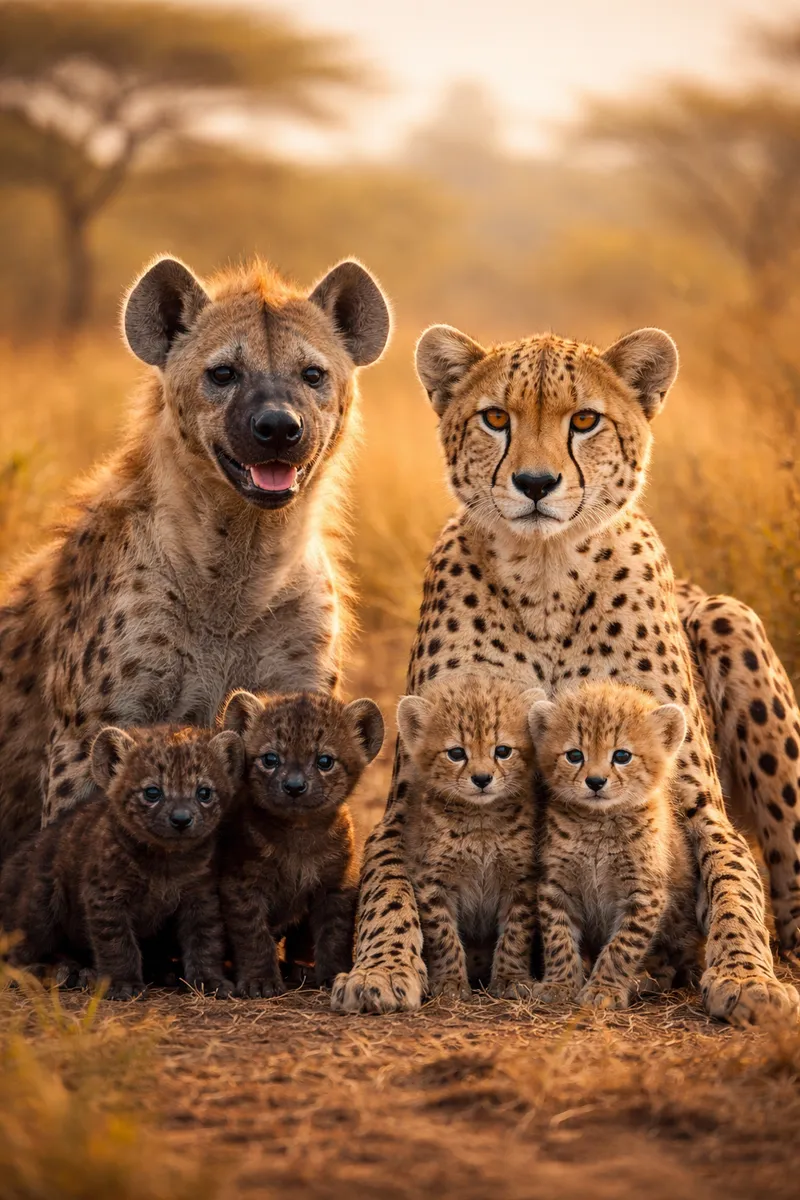
Parenting, According to Very Different Mothers
The hyena settled onto her haunches, finally serious — which, for a hyena, still looked suspiciously amused.
“We raise them together,” she said. “Aunts, sisters, cousins. Everyone watches. Everyone corrects. Everyone feeds.”
Her grin returned. “And everyone knows exactly who’s in charge.”
One of the younger hyenas shifted. She didn’t look at him.
He stopped moving anyway.
“Hierarchy,” the hyena continued, “is not cruelty. It’s clarity. My cubs learn early who eats first, who waits, and who doesn’t test me twice.”
From the shadows, the elephant rumbled quietly — approval or memory, it was hard to tell.
Above them, a hornbill muttered, “Effective.”
The cheetah listened without interrupting, then spoke — voice level, eyes steady. “My cubs don’t have a clan,” she said.
“So they learn discipline before comfort. Speed before confidence. Silence before celebration.”
She finally looked across the water. “They don’t get second chances. So I don’t pretend they will.”
The hyena studied her for a moment longer than usual.
“You know,” she said slowly, “humans would argue about which of us is doing it right.”
The cheetah didn’t hesitate. “They would,” she said.
“And then they’d try to do both — and panic when it got messy.”
A nightjar swooped low. “They always do.”
The hyena laughed again, softer this time. “Truth is,” she said, “your way works for your cubs. Mine works for mine. The bush doesn’t need agreement — just results.”
The cheetah inclined her head once. Pride, contained.
Near the dam, Rodney and Elzabé sat quietly, mugs cooling in their hands.
They had raised children. They had learned that there is no single method — only love, consistency, exhaustion, and doing the best you can with what you know at the time.
Rodney smiled faintly. “Same bush,” Elzabé murmured. “Different paths.”
Across the water, two mothers stood — one lean and silent, one loud and laughing — both successful, both unapologetic.
The dam reflected the stars, unimpressed.
The new year continued, unchanged. And somewhere in the dark, cubs slept — watched over in very different ways, yet equally well.
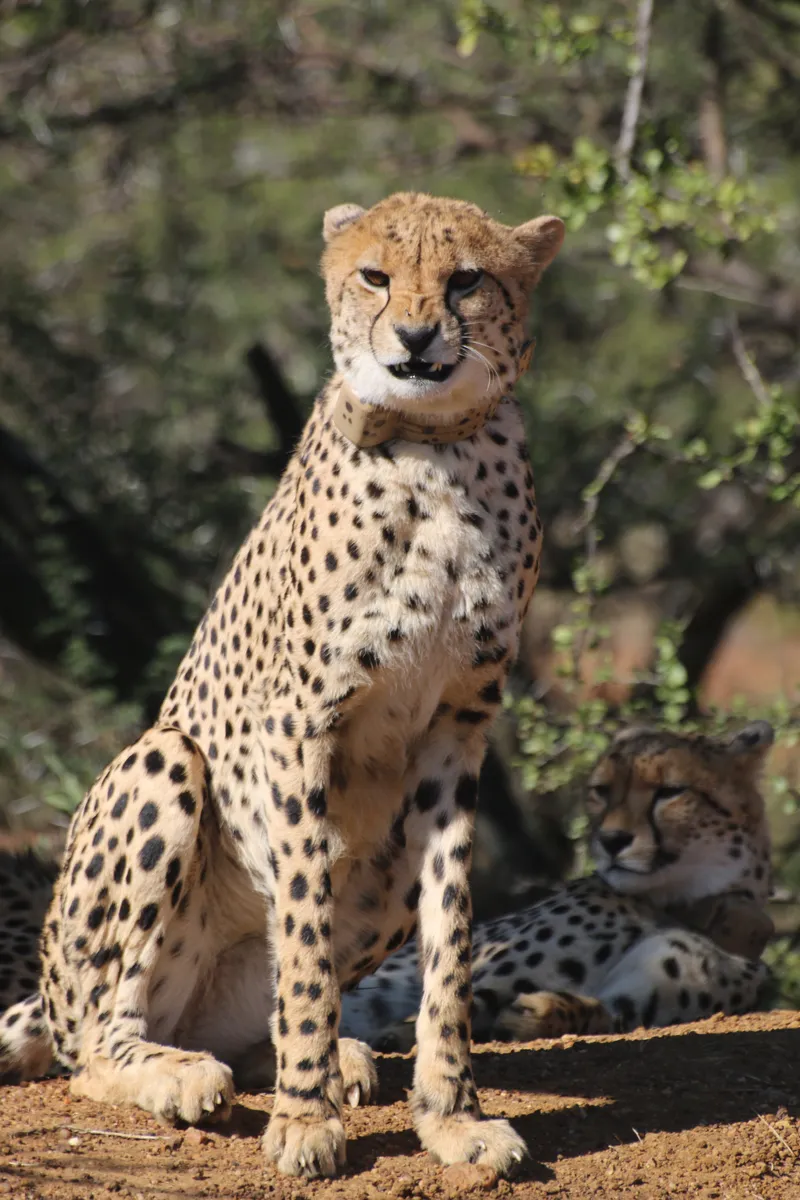
Noise vs Silence
“My cubs are born with their eyes open,” the hyena said proudly. “Teeth ready. Attitude included.”
“They argue immediately,” the cheetah muttered.
“They establish rank immediately,” the hyena corrected. “Important distinction.”
“My cubs learn silence,” said the cheetah. “Patience. Timing. When not to move.”
“Mine learn confidence,” said the hyena. “How to stand their ground. How to shout until something happens.”
Rodney raised an eyebrow. “Sounds familiar,” he whispered.
Elzabé smiled. “Teenagers,” she whispered back.
The Weaning Debate (Again)
“By eighteen months, my cubs are independent,” said the cheetah. “They leave. Sisters sometimes stay together. Brothers form coalitions. I’m done.”
“You evict them,” said the hyena.
“I prepare them,” said the cheetah.
“My cubs nurse for up to eighteen months,” said the hyena. “High-fat milk. Proper investment.”
“You delay,” the cheetah replied.
“We invest,” said the hyena. “My daughters inherit rank. They don’t leave. My sons disperse when ready. The clan remembers them.”
The cheetah stared at the dam.
“I don’t look back,” she said.
The hyena smiled knowingly.
“No mother ever really does.”
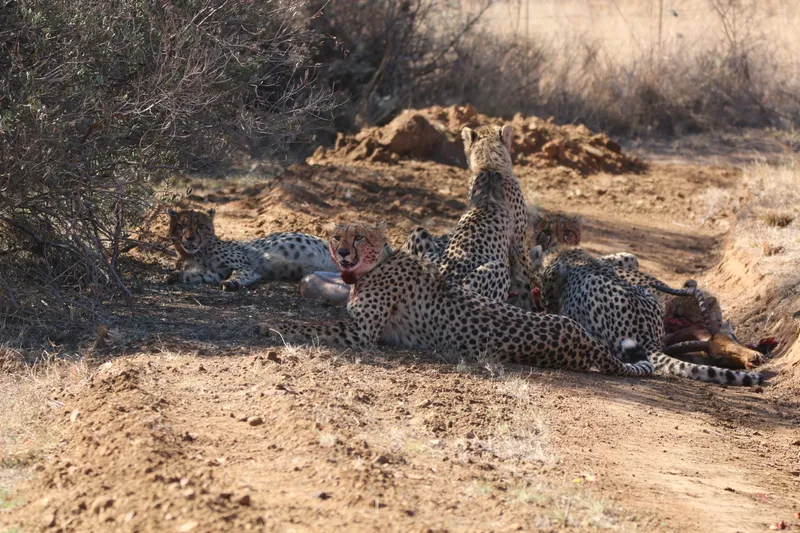
Speed, Endurance, and Arriving Slightly Later
“I hunt alone,” said the cheetah. “Stalk. Sprint. Precision. Short bursts. No wasted energy.”
“Yes, yes,” said the hyena. “Very fast. Everyone knows.”
“It’s not about speed,” snapped the cheetah. “It’s about acceleration. Turning. Ending it quickly.”
“And exhaustion,” added the hyena gently.
“We hunt together,” she continued. “Endurance. Pressure. Teamwork. Someone always breaks.”
“You steal,” said the cheetah.
“We finish,” said the hyena. “Often something we hunted ourselves.”
A pause.
“And sometimes,” the hyena added, “something you hunted first.”
Rodney quietly sipped his coffee.
“You’re welcome,” said the hyena.
Dens, Curiosity, and Humans with Cameras
“My dens are hidden,” said the cheetah quietly. “Moved often. If humans find them, cubs die.”
The hyena nodded. “Agreed. Cubs don’t survive curiosity.”
“Our cub losses are high,” the cheetah said. “Lions. Leopards. Mistakes.”
“Ours fight from birth,” said the hyena. “It’s brutal. But the strong survive.”
Across the dam, Elzabé felt the familiar knot of respect that comes from understanding how hard the bush is — and how little it owes anyone.
“Different strategies,” said the cheetah.
“Same risks,” replied the hyena.
Somewhere in the distance, a cooler lid slammed shut in another camp.
A voice whispered urgently, “Did you hear that?”
The cheetah didn’t look up.
“They promise to slow down,” she said calmly, “then they drive faster.”
“They promise to respect the bush,” the hyena added, amused, “while standing up in vehicles and pointing excitedly at absolutely nothing.”
“They promise change,” said the cheetah. “And repeat themselves,” the hyena grinned.
The dam settled again. Even the birds seemed to pause, listening.
“At least,” the cheetah conceded after a moment, “they help keep the reserve going.”
The hyena nodded, unusually sincere. “And they are endlessly entertaining.”
From above, the owlet clicked. “Mostly by accident.”
Near the caravan, Rodney and Elzabé exchanged a glance.
Fair again.
A New Year Begins
And so the new year arrived in the Dinokeng — not with fireworks or promises shouted into the dark, but with water drawn, cubs watched, laughter shared, and silence respected. Two mothers returned to the night in different directions, certain in their methods and steady in their purpose. Beside the caravan, Rodney and Elzabé finally stood, the fire long gone to ash, reminded once again that the bush does not ask for resolutions — only awareness, patience, and the humility to listen.
Elephant Epilogue
At the edge of the dam, the elephant remained long after the others had gone.
He stood with one foot resting lightly, trunk touching the water as if checking that it was still there — that some things, at least, had not changed overnight.
“Another year,” he rumbled softly, more to the stars than to anyone listening.
“Same lessons.”
He shifted his weight, ears folding once.
“Those who rush will still rush.
Those who watch will endure.”
Then, satisfied that the dam would hold, the paths would remember, and the bush would carry on regardless of human intentions, he turned and disappeared into the dark — slow, deliberate, unconcerned with calendars.
Thorn Tree Firelight
By the time Rodney and Elzabé finally stirred, the fire was nothing more than a warm scatter of ash. They didn’t rush to bed. They never did. Some moments deserve to be carried a little longer.
Around them, the bush had already moved on — mothers to cubs, elephants to paths, birds to first light. No speeches. No promises. Just continuity.
They poured the last of the coffee, stood quietly beneath the thorn trees, and let the new year arrive the way the bush always prefers it to — gently, honestly, and without ceremony.
Because here, where the wild still speaks, the firelight doesn’t mark endings or beginnings.
It simply reminds you to listen.
P.S. – From the Humans Camped Quietly Nearby
Dinokeng’s cheetahs are part of a carefully managed conservation success story.
The reserve is widely recognized as one of South Africa’s standout urban-edge cheetah conservation areas. The Endangered Wildlife Trust has reported Dinokeng supporting around 25 cheetahs at certain times — an impressive achievement for a fenced Big-5 reserve so close to major cities.
A 2024 feature by the Mail & Guardian placed the number closer to 21 cheetahs, noting that many are GPS-collared and actively monitored as part of South Africa’s cheetah meta-population program, coordinated through the EWT.
Because of this model, cheetah numbers in Dinokeng naturally fluctuate. Births, moralities and conservation-driven translocations are all part of keeping the population healthy and genetically diverse.
Among Dinokeng’s most respected cheetahs was the Rietvlei female, widely known as “Super Mom.” She earned her reputation by repeatedly achieving what is exceptionally difficult — raising cubs to independence in a Big-5 environment. One of her notable litters, five cubs recorded in March 2022, became part of Dinokeng’s living history.
Her passing on 6 February 2024 marked the end of a remarkable chapter, but not her legacy. The cubs she raised, and the genetics she passed on, remain part of the reserve’s story.
Alongside them, Dinokeng’s spotted hyenas continue to play a vital ecological role. Their structured clans, intelligence and adaptability make them efficient hunters, expert scavengers and the bush’s clean-up crew — ensuring very little goes to waste.
Two species.
Two strategies.
One shared landscape.
And long after the New Year’s fires have cooled, the conversations at the dam continue.