
The Thunder That Announces a King -woodlands kingfisher 2
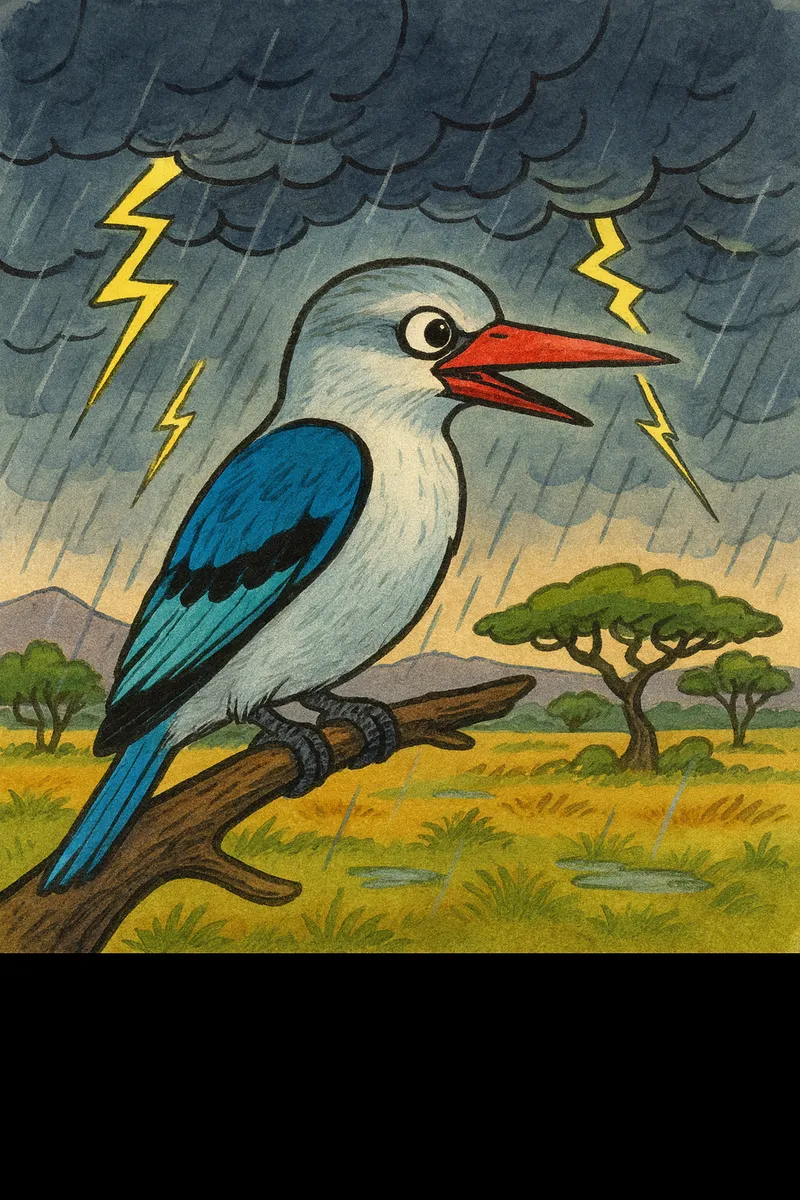
The Thunder That Announces a King
A Thorn Tree Bush Camp Firelight Tale
It always starts with a rumble.
Not the polite, distant kind you hear from Joburg traffic or the polite grumble of a warthog trying to find a comfortable spot in the shade. No — this one rolls in like an old ox-wagon pushed by giants, deep and resonant, shaking the tin roofs of the Thorn Tree tented cabins just enough to send Shilo into her usual heroic panic.
“It’s coming from Botswana,” Elzabé said confidently that afternoon, leaning on the railing of the Monkey Thorn deck. “Or Namibia. Definitely west.”
And she was right — because here in the bushveld, we all know the pattern.
The first proper summer storm hardly ever sneaks in from the polite Indian Ocean side. Oh no. The early-season ones prefer to swagger in from the west and north-west, building over the flats of Botswana, gathering mischief above Namibia, fattening themselves on Kalahari heat before marching toward Dinokeng with an attitude.
By the time they reach Thorn Tree, they look like they’ve wrestled a dust-devil, arm-wrestled a camelthorn tree, and lost a poker game to a cloud from Angola.
And every old farmer from Pretoria to Polokwane knows the saying:
“The first rain comes around the 10th of October — Oom Paul’s birthday.”
It’s one of those bits of bushveld folklore that somehow persists because it keeps being true just often enough. Generations of boerboele, birders, game rangers and schoolchildren raised on “Pa se weerwysheid” still watch the western sky around the 10th, waiting for that first electrifying flash.
This year was no different.
On the morning of 9 October, Thorn Tree Bush Camp sat under a heavy, breathless heat that felt like the world was holding its lungs in. The grass was brittle, the air hummed with insects, and every squirrel had the same expression:
“If we don’t get rain soon, I swear I’ll throw myself at the next rocket boiler for mercy.”
Then came the clouds.
Towering, bruised, swelling in layered anvils above the distant bush.
Botswana was sending us a present.
Namibia was wrapping it in thunder.
And the Kalahari was personally delivering it with express lightning.
Even before the first drop fell, the camp came alive with anticipation.
The Breath Before the Break
Rodney was in his usual late-afternoon patrol mode — kicking a tyre here, checking a tent flap there, and pretending the bowing windmill didn’t remind him of the one in Newcastle that nearly decapitated him in the 80s.
Shana stood outside the Fever Tree Tented Cabin with her hands on her hips, grinning like a child waiting for fireworks.
“It’s a big one,” she declared.
Even the staff felt it.
KK paused chopping wood.
Margaret moved laundry inside a little faster.
And Tim, philosophical as ever, simply said:
“The Rain she is Coming again.”
Then, on cue — the first summer lightning strike cracked across the sky, splitting the horizon open like an egg of pure white fire.
Shilo, brave guardian of the realm, gave a valiant bark and immediately reconsidered all her life choices and darted to Mom" Elzabe" for protection, after all what does a Kiwi dog Know about lightning.
And then—
as if some ancient bushveld conductor had tapped his baton— the rain finally spilled.
Thick, heavy drops.
The kind that taste like dust releasing its last sigh.
The kind that turn hard earth into the aroma of “first wet dust,” the unofficial perfume of October in Dinokeng.
It was in that exact moment — while the camp shook under thunder rolling from Botswana and lightning stitched the sky — that the second great sign of the season arrived.
A whistle....... Sharp........ Clear. followed by a long, vibrating trill that made the hair on every arm stand up.
Elzabé froze and pointed. “He’s back.”
Enter the Drama King: The Woodland Kingfisher
If the thunderstorms are the opening act of the bushveld summer, the Woodland Kingfisher is its headline performer.
And not the quiet kind of performer either — oh no.
He arrives like a rock star returning from a world tour.
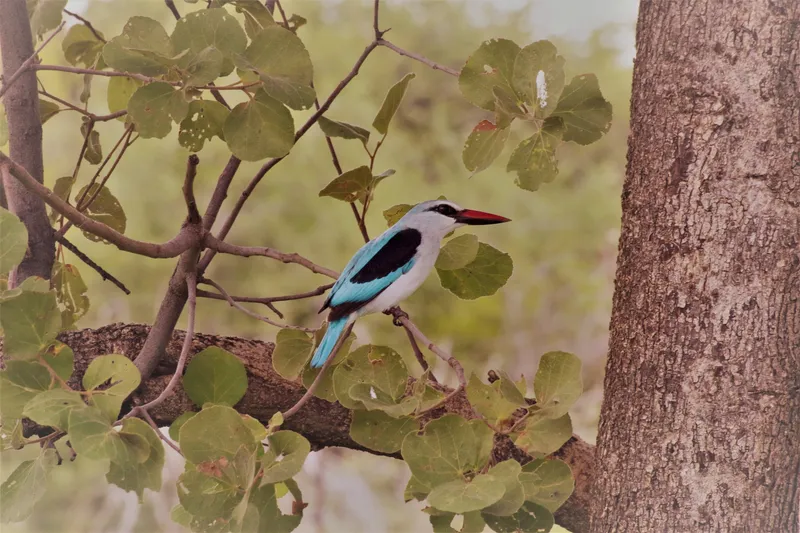
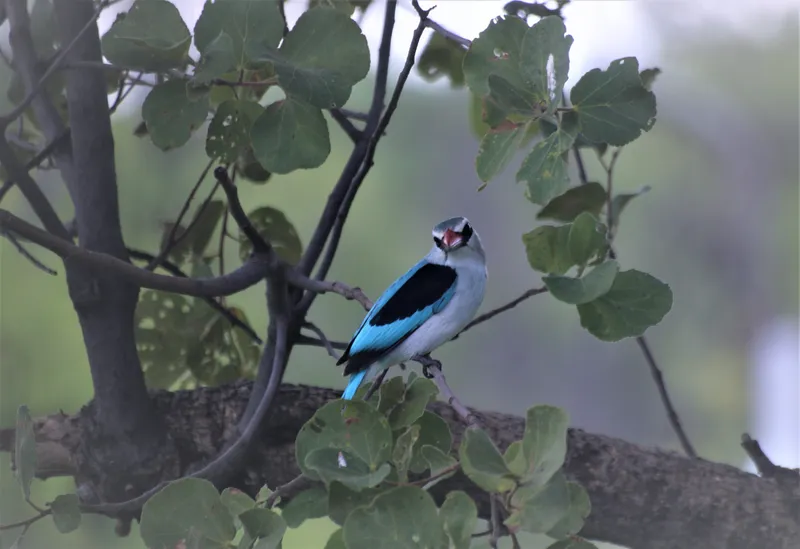
One moment the storm is drumming away overhead, and the next: a flash of electric turquoise lands on the dead acacia branch above the Weeping Boer-bean Tented Cabin.
There he sat — bold as brass, feathers gleaming like a gemstone dipped in skywater.
“Tiu!” he shouted, because subtlety is not part of his personal brand.
Then came the famous trill: “Trrrrrrrrrrrrrrr…”
Loud enough to wake any sleeping guest.
Loud enough to make the squirrels swear.
Loud enough to let Thorn Tree know:
“Ladies and gentlemen, summer has officially begun.”
A Traveller of Africa

For a bird that could easily fit inside a hat, this flashy fellow has a passport more stamped than Rodney’s.
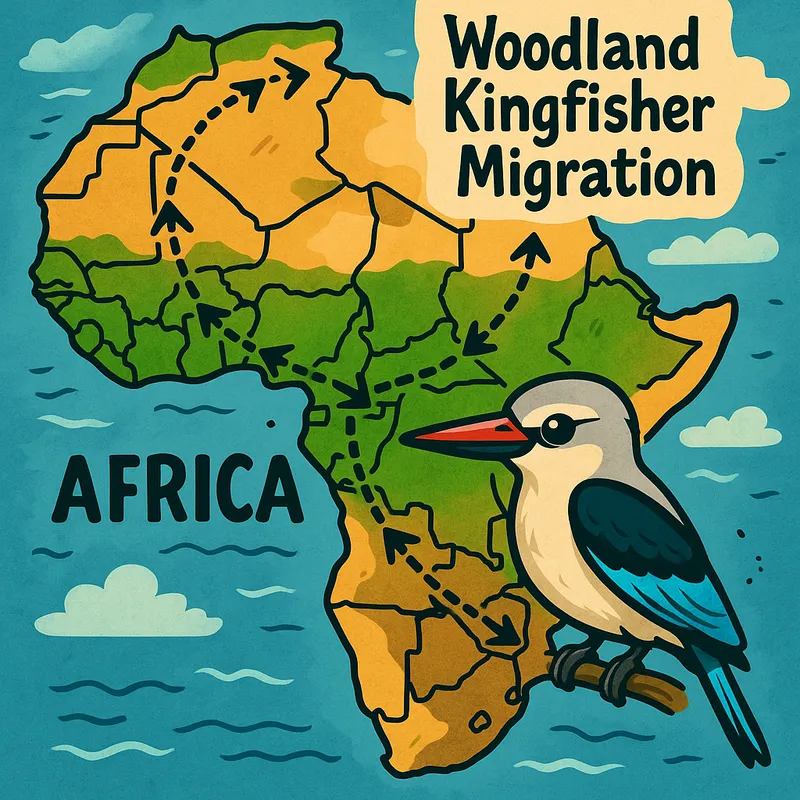
Each year, as the southern hemisphere winter creeps in, the Woodland Kingfisher packs his metaphorical suitcase and heads north — sometimes thousands of kilometres.
Tracking shows some fly over 4,000 km, cruising through Zambia, Tanzania, Uganda and even towards the edges of the Sahel.
But around late October — yes, right on Oom Paul’s favourite week — the storms start brewing over Botswana, and something primal calls him homeward.
He follows:
the heat
the rumbling thunder
the smell of rain
the blooming insects
Until finally he descends into South Africa with the swagger of a returning VIP.
And of all the trees in Dinokeng, he chooses your campsite to announce his arrival.
The Kingfisher’s Real Personality (Spoiler: He’s a Drama Queen)
The Woodland Kingfisher is the bushveld’s version of that neighbour who announces his return from holiday by hooting three times, shouting hello at the top of his lungs, and immediately complaining about the state of the driveway.
Facts? Yes.
But the personality? Much better.
His call is basically bushveld karaoke.
That “tiu… trrrrrrrrrrrr” is iconic — documentaries use it as soundtracks for “Africa moments,” and guests at Thorn Tree learn very quickly that it is the 4:30 a.m. alarm they did NOT set.
He is aggressively territorial.
He will chase:
hornbills
rollers
squirrels
monkeys
the occasional guest with a cup of morning coffee
and literally anything that comes near his nesting hole
All with the confidence of a bouncer who weighs 300 kg and has seen things.
He’s the best-dressed bird on the block.
Electric-blue wings.
White chest.
Black shoulder patch.
Two-tone red-and-black bill
— the kind of colour scheme that makes other birds whisper, “Who does he think he is?”
And he’s not actually a fisherman.
Despite the name, he rarely goes near water.
Instead, he hunts grasshoppers with the accuracy of a tiny, furious assassin.
He swoops, grabs, then… WHACK-WHACK-WHACK
— bashes the insect against a branch with such gusto that even the hornbills look away politely.
Real Estate, Romance & Raising Royalty
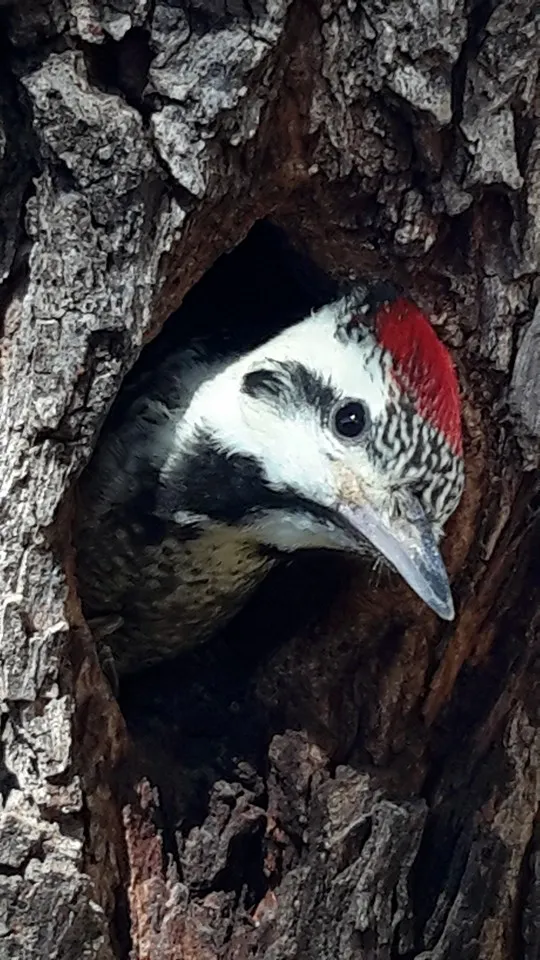
The moment he arrives, the Woodland Kingfisher heads straight for the old Scented Pod Tree outside Reception — that gnarled Lekkerruikpeul that has hosted more bushveld tenants than a Hillbrow high-rise. Bearded Woodpeckers, Red-billed Hornbills, quarrelling Green Woodhoopoes, even bushbabies with their fuzzy toes dangling out of hollows… it’s a fully booked wildlife apartment block.
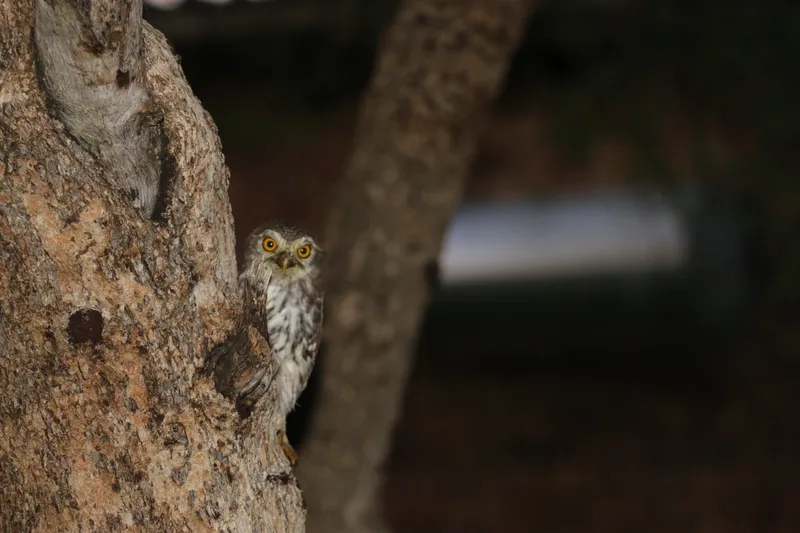
So when the kingfisher lands there, his turquoise feathers blazing against the battered bark, he inspects the holes like a stern landlord checking occupancy. One sharp “TIU!” rings out — bushveld code for: “I’m taking this one.”
He and his partner move in immediately, choosing a pre-dug barbet or woodpecker hole because, really, why dig when someone else has done the renovations? From October to March they run the nest like overcaffeinated newlyweds: incubating, feeding, defending, and shouting at anything that moves.
Then the chicks hatch — grow like they’ve discovered protein shakes — and finally launch themselves into the world around Thorn Tree with all the elegance of teenagers learning to drive: loud, enthusiastic, and slightly hazardous.
A King With a Job to Do
Don’t be fooled by the attitude.
The Woodland Kingfisher plays a crucial ecological role.
He controls insect populations ; Including grasshoppers, which can explode after rains.
He’s part of the cavity-nester community; Recycling old nesting holes, and later leaving them for other species to use.
He’s the soundtrack of our summers; The bushveld without his call would feel… incomplete. Quiet. Wrong.
He’s one of the living calendars of the highveld — just like the first Acacia blossoms or the arrival of the thunderclouds.
Storms, Birds & Bushveld Culture — A Perfect Blend
The beauty of Thorn Tree Bush Camp is that everything here connects:
The storms rolling in from Namibia and Botswana
The rainfall folklore of Oom Paul
The first insects emerging from the grass
The return of the Woodland Kingfisher
The animals shaking off the dust
The staff lighting the rocket boilers at dawn
And Shilo, bravely barking at the thunder before Climbing all over Elzabe for protection
It all folds into the rhythm of bushveld life.
The kingfisher’s arrival isn’t just a bird sighting.
It’s a symbol:
The rains are here.
The heat is bearable again.
The bush is waking up.
And summer at Thorn Tree has officially begun.
it’s the moment when everything — from termite mounds to tent poles — seems to sigh with relief.
The Morning After
When dawn finally broke after that dramatic first storm, Thorn Tree wore a new coat of colour.
The sand was dark and cool.
The leaves glistened like polished jade.
The resident squirrels were already complaining (they always do).
And every branch dripped with the promise of new life.
Then came his voice again.
“Tiu… trrrrrrrrrrr…”
There he was — perched proudly above the Umbrella Thorn Family Tent, chest puffed, feathers gleaming, looking like he personally brought the storm with him.
Guests stepped out of their tents with sleepy grins.
KK lit the first rocket boiler of the season.
Margaret hung up washing that would actually dry properly now.
Shana sipped her coffee and said:
“Now it feels like Thorn Tree again.”
And she was right.
Because the Woodland Kingfisher is Thorn Tree’s unofficial welcome-back committee.
He is the riotous herald of summer.
The noisy little prophet of rain.
The turquoise thunder that follows the storm.
Epilogue — A Thorn Tree Tradition
Later that evening, as the fire crackled and the air still smelled faintly of rain and damp earth, a guest asked Rodney:
“Is it true the rain always comes on the 10th of October?”
Rodney poked the fire, nodded sagely, and said:
“Ja, around then. But if you’re ever unsure…”
He paused, listening.
A sharp whistle rang out from the canopy.
“Just ask the kingfisher.”
Because here in Dinokeng —
when the storms roll in from Botswana, and the Woodland Kingfisher calls from the thorn trees, you know the bushveld summer has come home.