
Before Names, There Was Respect
This story is told as it might have been shared for generations: by an elder, by firelight, passing knowledge to his sons. Some words are Zulu, because the bush was speaking long before English arrived.
Why the Mlungu Gave Them Names
Before the fire has fully settled, Siphesihle speaks. “Baba,” he asks, “why did the mlungu give these animals names like white and black rhino — when they are both the same grey?”
I shake my head slowly and smile. “My son,” I say, “this is one of the bush’s favourite jokes.”
Long ago, when the first Dutch settlers watched this animal feeding, they called it wijd — wide.
They were not speaking about colour. They were speaking about the mouth.
That wide, square mouth — built like a shovel — belongs to the animal you now hear called the white rhinoceros.
Later, English ears heard wijd and thought it meant white.
I pause, letting the fire crackle. “And instead of asking questions,” I say, “they wrote it down.”
Siphesihle smiles.
“That wide mouth,” I continue, “is made for grass. The white rhino is a grazer. Head down, slow and patient, moving across the plains like an old man mowing a very large lawn.”
“And the black rhino?” Sibusiso asks.
“The black rhino,” I say, “was named mostly because people needed something to call the other one. Sometimes they said it was because of dark mud after wallowing — but again, it was never really about colour.”
I hold my fingers in the firelight, shaping a hook. “The real difference is here. The black rhino has a pointed, hooked lip — made for plucking leaves, twigs, and shrubs. He is a browser. He chooses. He does not rush.”
Thulani nods once. He has seen those neatly cut twigs and did not need the explanation.
“So,” I say, “white and black rhino — two grey animals — named not for what they are, but for how humans heard things three hundred years ago.”
I poke the fire gently.
“It is not the first time people have named something without first understanding it.” The bush, as always, keeps its opinion to itself.
Hlalani Phansi, Madodana Ami
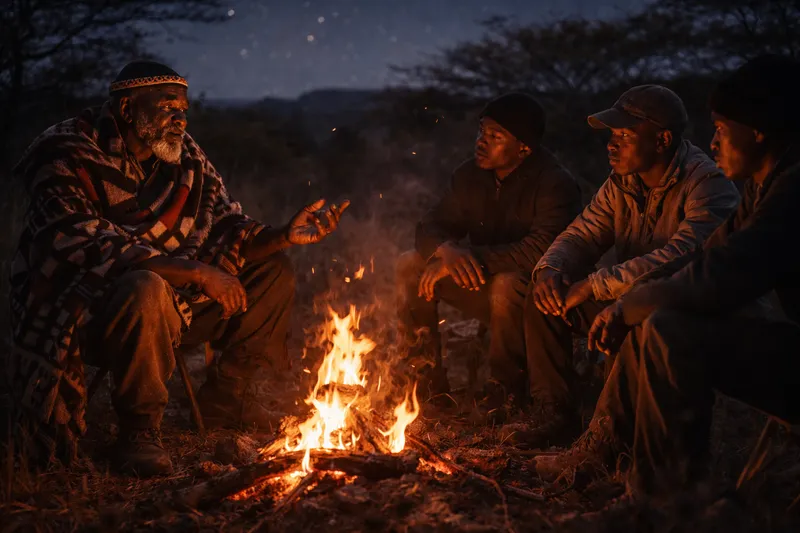
-Hlalani phansi, madodana ami. Sit closer to the fire.
My name is uBaba Mkhululi, and these are my sons: Thulani, Siphesihle, and Sibusiso.
Thulani is the quiet one — the watcher of signs.
Siphesihle is the one who asks careful questions.
Sibusiso is the youngest, curious and quick to wonder.
Not because the night is cold, but because the bush speaks softly — and a man who listens from too far away hears only himself.
You ask me about the rhino.
You ask why people argue about its value, its protection.
You ask why men kill something so old for something so small.
Before I answer, listen to the ground.
The Rhino as the Bush Knows It
The rhino does not announce itself.
It does not greet the sun or warn the grass.
It arrives — and the bush makes space.
Grass folds. Branches complain softly. Birds rethink their plans.
The ground itself seems to listen.
That is how you know umkhombe matters.
He lives by a simple rhythm: eat, move, wallow, rest.
He does not rush.
He does not posture.
When pushed too far, he responds with certainty — not anger.
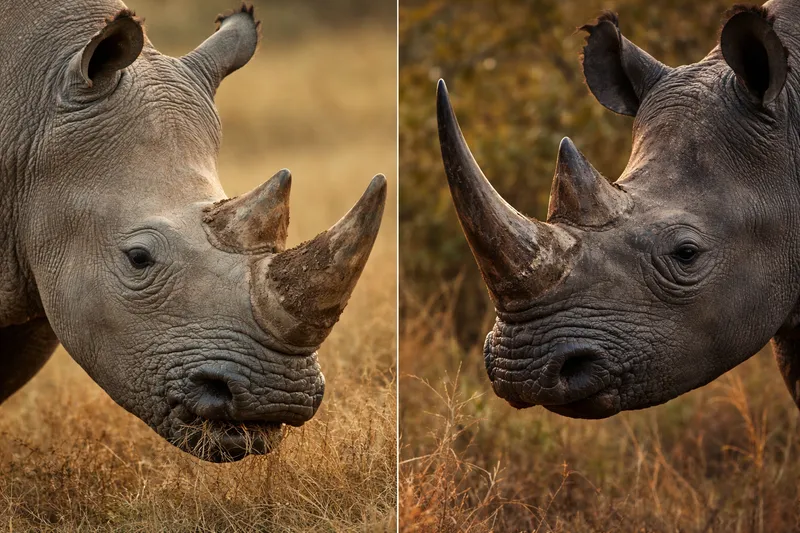
How the Land Recognises Umkhombe
Look where the grass lies flat, as if pressed by a heavy thought.
That is where one kind of rhino feeds — head low, mouth wide, mowing the plains patiently.
Now look to the thicket.
See the narrow paths, broken thorn, and quiet gaps of light.
That is the other one — head higher, lip hooked, sculpting bush rather than flattening it.
Thulani notices these things without speaking. He always does.
One moves with others when it chooses.
The other walks alone, like an elder who needs no audience.
Even their signs speak.
One leaves dung where it falls.
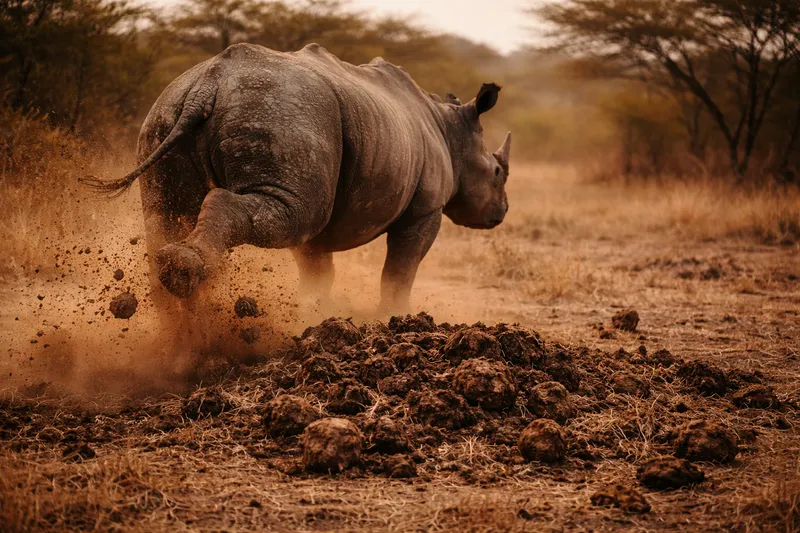
The other returns again and again to a midden — a meeting place of messages written in smell and soil. There he scatters his dung with his feet, telling the land:
Ngikhona. I am here.
Nearby, twigs are cut cleanly at an angle.
Not broken — cut.
A quiet signature of a hooked lip feeding with intention.
The land reads these signs easily.
Humans walk past them, trip over the evidence, and still ask if rhino are here.
What We Called Him — and Why That Was Enough
We called him umkhombe.
One word.
Heavy.
Complete.
We did not say black or white. We did not divide what the ancestors had already explained.
Umkhombe is not just an animal. It is a warning and a lesson.
It means strength that does not shout.
Danger that does not need explanation.
A being that walks alone — and therefore must be respected.
There is an old saying: “Isilo siyahlonishwa.” A powerful creature is met with respect — not noise.
When something fears nothing, you do not challenge it.
You greet it by keeping your distance.
That is not fear. That is wisdom.
What Umkhombe Taught Our Fathers
Our fathers taught us that the rhino carries isithunzi — weight, presence, consequence.
Large animals that walk alone — rhino, elephant — were never treated lightly.
They were close to the ancestors (amadlozi), not because they were spirits, but because they reminded us that we are not the strongest thing in the world.
If such an animal was ever taken, it was done with reason.
With ritual.
With apology.
Because when you kill something that old, the ancestors are watching how you behave afterwards.
That is how balance (ukulinganisela) was kept.
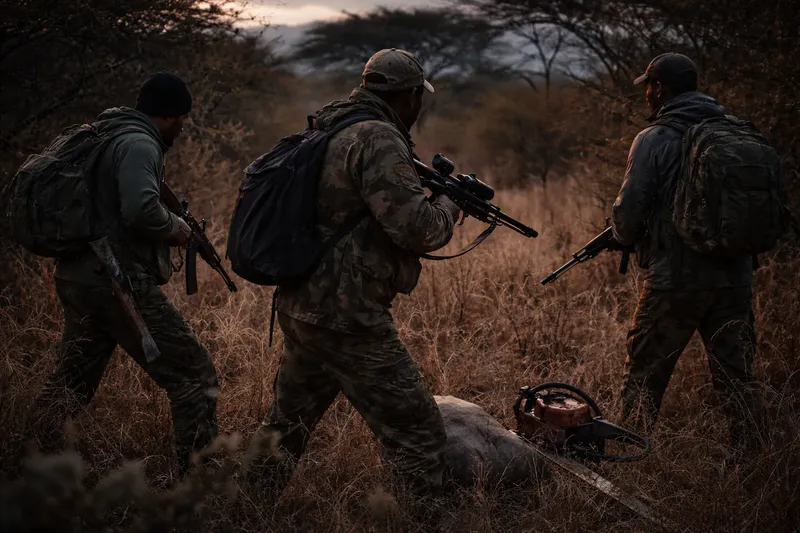
When Umkhombe Became a Thing
Then came the worst change of all.
The rhino stopped being umkhombe.
It became a thing.
Men far away decided its horn meant power, medicine, status.
They had never watched a rhino stand in dust at sunset, listening only to wind.
They saw money where the bush saw balance.
A Question by the Fire
The fire settles, and for a while no one speaks.
Thulani nudges a stick into the coals, watching the sparks lift and disappear.
Siphesihle clears his throat.
“Baba… they say the horn makes a man strong.
Is that why umkhombe is killed — and only the horn taken?
When we hunt, we waste nothing.
We eat everything that can be eaten.
This feels like such a waste.”
Before I answer, Sibusiso frowns. “Then why do men believe it?”
I answer slowly, letting the fire settle first.
“Amandla awahlali ephondweni — ahlala enhliziyweni nasemkhubeni womuntu.”
Strength does not live in the horn. It lives in a man’s heart, and in the way he walks the world.
Siphesihle lowers his eyes, turning the words over carefully.
Thulani nods once — he has already read this truth in the bush.
Sibusiso leans closer, listening as if the night itself might ask him later.
“We, as Zulu men of Africa,” I continue, “do not need potions made from rhino horn to make us strong.
We were made strong already — by the land, by work, by responsibility, by how we are expected to behave.”
“When we hunt,” I say, “we take only what we need, and we waste nothing.
We eat what can be eaten.
We thank the animal.
That is how strength shows itself.”
I smile, just a little. “If horn made men strong, madodana ami, we would be chasing porcupines — not rhinos.”
The fire cracks softly.
The bush remains quiet.
When Sibusiso Asks About the Middens
Sibusiso points at the ground and wrinkles his nose.
“Baba, why does umkhombe always leave his dung in the same places?”
I smile and tell him to look down properly — not away.
“My son, rhinos do not whisper to the land. They leave messages.”
Both kinds of umkhombe use dung middens — places chosen carefully, returned to again and again.
These are not accidents.
They are the bush’s noticeboard.
The difference is in what the dung tells us.
The white rhino, a grazer of open plains, eats grass and little else. His dung is packed and fibrous, full of grass, and often looks the same wherever you find it.
The black rhino lives in thicket and bush. He eats leaves, twigs, bark. His dung carries those pieces with it, sometimes with twigs cut cleanly at an angle by a hooked lip.
That is how you know who has spoken.
“And when you see dung kicked and spread around the midden,” I add, “do not think it careless.
That is announcement — most often a territorial white rhino bull making sure the message travels far enough.”
The land understands these signs easily. Humans, meanwhile, step around a midden, wrinkle their noses, and keep walking — never realising umkhombe has already spoken, clearly and politely, to anyone willing to look down.
When Men Are Used
I add another piece of wood to the fire before speaking again.
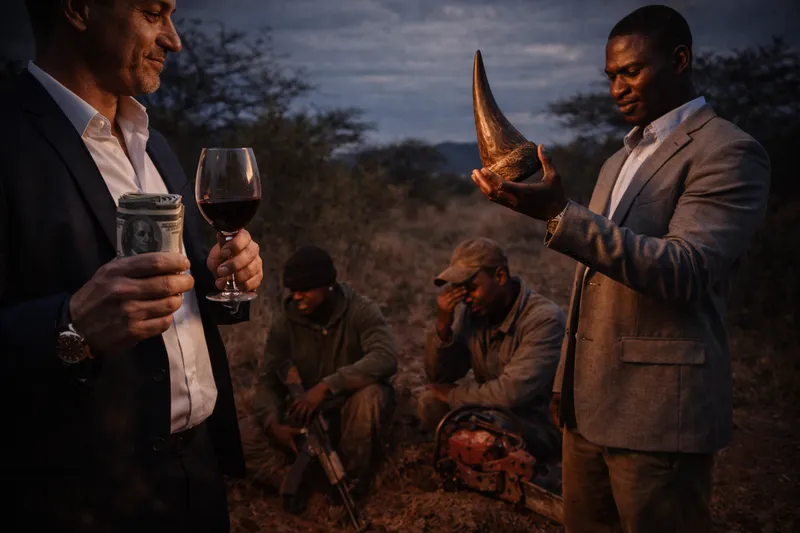
Those with the least are used the most. The land pays the price.
“My sons, you must understand this.”
The men who come for umkhombe are not always bad men.
Many are hungry.
Many are tired.
Many are men made weak by others.
Far away, syndicates never touch the bush.
They use money, drugs, and alcohol to dull thinking and sharpen desperation.
They promise quick strength and easy escape.
They take the horn and leave the man behind.
The man who pulls the trigger is paid once.
The men who send him are paid again and again.
What is not said is this:
When the rhino is gone, the money is gone.
The work is finished.
The bush is empty.
Then those who used him move on, and he is left with nothing —no rhino, no future,and a land that no longer feeds him. Africa has lost one of its Icons - no child will see in teh future.
I speak quietly now. “Umuntu ugawulwa yizono zakhe.” -A person is destroyed by his own actions.
“A man protects what will still feed his children,” I say. “He does not sell tomorrow for a drink today.”
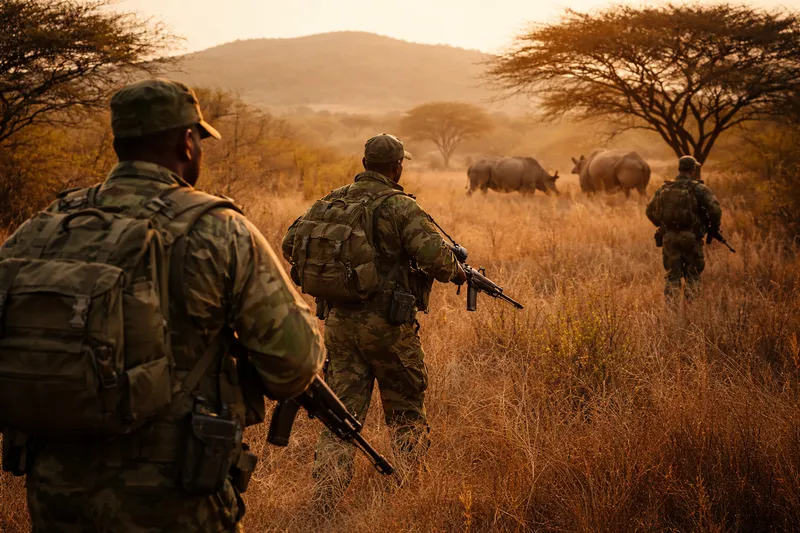
Where Hope Lives — and What It Costs
Hope lives in places like Dinokeng and other reserves across Africa.
There, people walk long nights so rhino may walk the morning.
They carry radios, rifles, and tired eyes.
They spend fortunes so silence does not fall forever.
The better the protection, the greater the cost.
The stronger the shield, the greater the target.
Hope exists — but hope is expensive.
What You Must Remember
The fire has burned lower now.
Thulani still watches the bush beyond the firelight, reading what others miss.
Siphesihle carries the lesson inward, knowing it will travel with him.
Sibusiso leans closer to the warmth, quieter than before — but wiser.
I look at them all.
“Remember this, madodana ami.
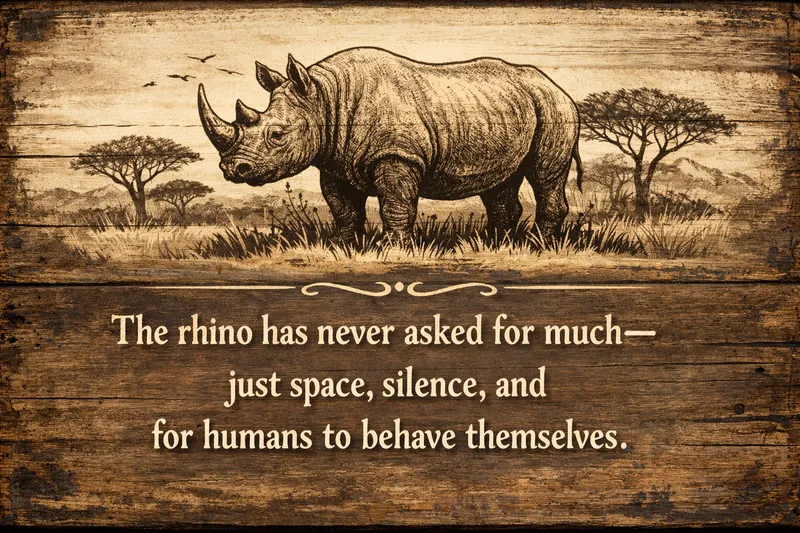
The rhino has never asked for much — just space, silence, and for humans to behave themselves.
Before names, there was knowing.
Before trade, there was respect.
Before fences, the land protected itself — because people listened.”
The bush remains quiet.
That is how I know it agrees.
Now add wood to the fire.
The night — and the ancestors — are listening.